Summary: Getting your home's price right starts with understanding real market data. Explore how a Realtor in West compares local sales, tracks buyer demand, studies market trends, and creates a pricing strategy that helps attract serious buyers while protecting your home's value.
Setting the right price for your home is one of the biggest decisions you will make before putting it on the market. Price it too high, and buyers may ignore it. Price it too low, and you could miss out on money. That is why working with an experienced Realtor in West makes such a difference. Instead of relying on guesswork, a skilled professional uses accurate market data to find a price that attracts buyers while protecting your investment.
Home values are always changing. Local trends, buyer demand, neighborhood activity, and recent sales all play a role. Understanding these details helps create a pricing plan that gives your property the best chance of selling at a fair price.
Why Market Data Matters More Than Opinions
Every homeowner has an emotional connection to their property. You may remember family celebrations, home improvements, or years of hard work taking care of the house. While those memories are priceless, buyers focus on what the current market says.
Market data removes personal opinions from the pricing process. Instead of asking what a home feels like it is worth, your realtor looks at facts such as:
● Recent home sales
● Current listings
● Homes that failed to sell
● Average days on the market
● Buyer demand in your area
These numbers give a much clearer picture than personal estimates or online calculators.
Looking at Comparable Home Sales
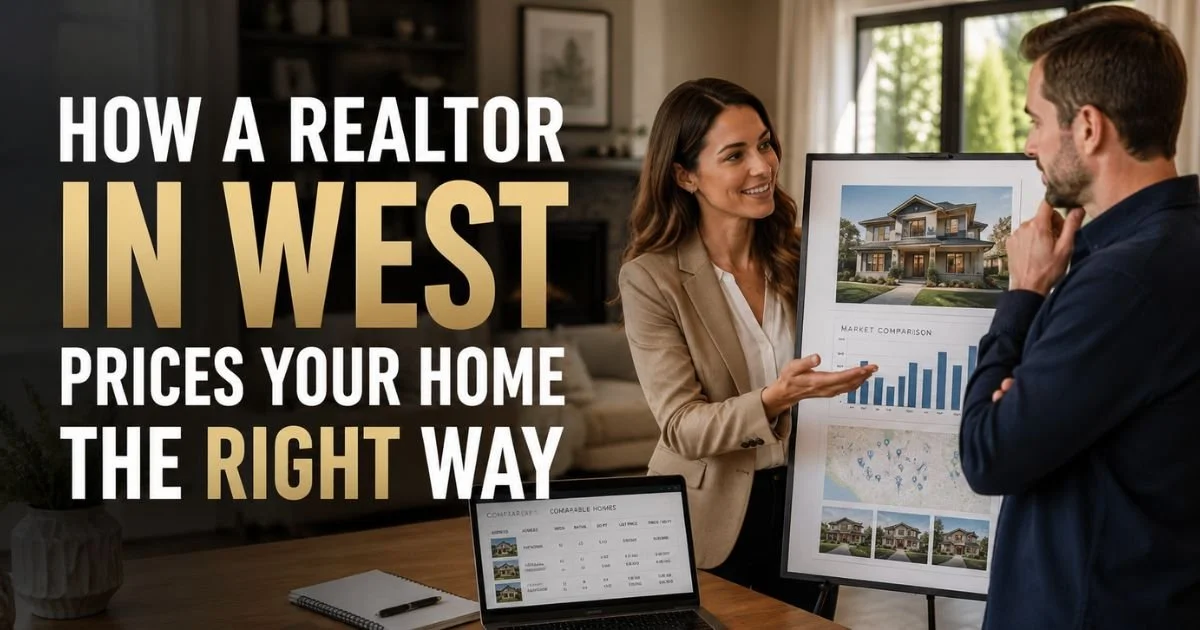
One of the first steps a Realtor in West takes is reviewing comparable sales, often called "comps." These are homes that recently sold and have similar features to yours.
Your realtor compares details such as:
● Square footage
● Number of bedrooms and bathrooms
● Lot size
● Home condition
● Age of the property
● Renovations and upgrades
● Neighborhood location
The goal is not to find identical homes. Instead, it is to identify homes that buyers would see as similar while making changes for differences.
This comparison creates a realistic price range based on what buyers have actually paid.
Understanding Current Competition
Pricing is not only about homes that already sold. It is also about the homes buyers are looking at today.
Imagine your home is listed with several similar properties. If yours is priced much higher without offering extra value, buyers may skip it.
A knowledgeable realtor studies active listings to answer questions like:
● How many similar homes are available?
● What price range attracts the most attention?
● Which homes are receiving offers quickly?
● Which homes have been sitting on the market?
Understanding the competition helps place your home in a stronger position.
Watching Local Market Trends
Real estate markets change throughout the year. A neighborhood that was very competitive six months ago may look very different today.
A Real Estate Agent in West keeps track of local trends such as:
● Rising or falling home prices
● Number of homes for sale
● Seasonal buying patterns
● Mortgage rate changes
● Average selling prices
● Number of new listings
These trends help decide if pricing should be slightly higher or more competitive based on current buyer activity.
Evaluating Buyer Demand
Not every neighborhood gets the same level of buyer interest.
Some communities receive multiple offers within days, while others take more time. Market data helps measure buyer demand by tracking:
● Number of property showings
● Online listing views
● Open house attendance
● Recent offers on similar homes
● Average time before receiving an offer
Strong buyer demand may support a higher listing price. Slower activity often calls for a more competitive approach.
Understanding this balance helps avoid pricing mistakes that could slow down your sale.
Considering Your Home's Unique Features
Numbers are important, but every property has its own story.
Your realtor also looks at features that may increase or reduce value, including:
● Updated kitchens
● Modern bathrooms
● Energy-efficient improvements
● Outdoor living spaces
● Finished basements
● Home offices
● Corner lots
● Scenic views
These details help explain why two homes with similar sizes may sell for different prices.
The goal is to make sure your property's best features are included in the final pricing plan.
Avoiding the Risks of Overpricing
Many homeowners believe they can simply lower the price later if needed. While that sounds reasonable, it often creates new problems.
An overpriced home may:
● Stay on the market longer.
● Receive fewer showings.
● Make buyers wonder if something is wrong.
● Need multiple price reductions.
● Sell for less than expected.
Buyers often think there is something wrong with a property that remains unsold for weeks.
Pricing correctly from the beginning creates stronger interest and often leads to better offers.
Why Underpricing Is Not Always the Answer
Some sellers believe pricing low guarantees a quick sale. While that may attract attention, it can also reduce your potential profit.
Market data helps find a price that attracts buyers without giving up value.
The right balance creates healthy competition while giving you the chance to receive strong offers from serious buyers.
Data Helps During Negotiations
Pricing does not stop working once an offer arrives.
A realtor continues using market data during negotiations by explaining how your asking price compares with recent sales and current market conditions.
If buyers ask for a lower price, your realtor has real facts to support your home's value instead of relying on opinions.
This creates stronger, more confident negotiations for both sides.
Technology Supports Better Pricing Decisions
Today's real estate professionals have access to advanced tools that provide better market information.
These tools can analyze:
● Pricing trends
● Neighborhood value growth
● Buyer activity
● Past sales
● Property comparisons
● Changes in local housing supply
Technology makes research faster, but experience is still the most valuable part of the process.
An experienced realtor knows how to understand the data and use it for your unique property instead of depending only on automated estimates.
The Right Price Creates More Opportunities
When your home is priced correctly from the start, more buyers are likely to schedule showings.
Greater interest can lead to:
● Faster offers
● Better negotiations
● Increased buyer confidence
● Better market visibility
● A smoother selling process
The right price creates momentum that helps your listing stand out in a competitive market.
Final Take:
Selling your home is a big moment, and the right pricing strategy can shape the entire experience. At Juan Munoz - Realtor - The Apollo Group - eXp Realty, we focus on helping your home make a strong first impression with buyers by using real market insights instead of guesswork. As your trusted Realtor in West, we work to position your property where it can attract attention, generate interest, and compete with confidence.
If you are ready to put your home on the market, connect with our experienced Real Estate Agent in West today. Let's build a pricing strategy that helps you move forward with confidence and achieve the results you deserve.
FAQs
Q1:How does a Realtor in West decide the right price for a home?
A Realtor in West studies recent home sales, local market trends, buyer demand, and similar properties to determine a competitive price that attracts serious buyers.
Q2:Why is market data important when pricing a home?
Market data shows what buyers are paying for similar homes. It helps sellers set a realistic price based on current market conditions rather than personal opinions.
Q3:What happens if a home is priced too high?
An overpriced home may receive fewer inquiries, stay on the market longer, and eventually require price reductions to attract potential buyers.
Q4:Can a Real Estate Agent in West help me avoid underpricing my home?
Yes. A Real Estate Agent in West uses local market insights and comparable home sales to help you set a price that reflects your property's true value.
Q5:What are comparable home sales?
Comparable home sales are recently sold properties with similar size, features, condition, and location. Realtors use them to estimate a fair and competitive listing price.